Flashcards for kids with pictures and explanations
With Concept Cards, pupils learn words and concepts through a picture, a word and an explanation. The front of the card might show a picture and the back the word with its explanation, so the pupil links the concept to its meaning instead of memorising a bare word.
The cards come from Puro’s concept library. Every concept has a word and an explanation in seven languages, and most have a picture too. You don’t need to write or illustrate anything: pick the word sets and the activity is ready. Once the words are familiar, they can be revised with a memory game.
Try the exercise
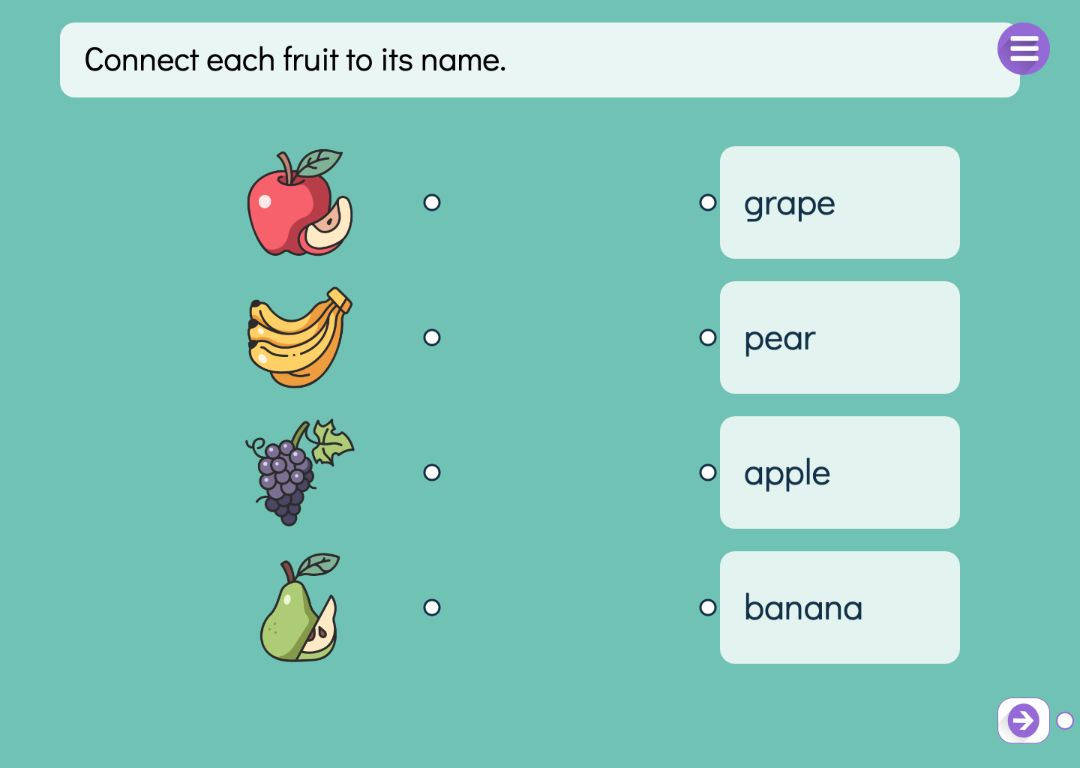
This exercise was made with Puro Editor. Try it yourself – this is exactly what your pupils see.
Three ways to practise
In the form you choose what the pupil does with the cards.
- Flashcards
- The pupil flips the card and decides whether they knew it. A known card leaves the pack, and one they did not know yet goes to the back of the pack. The pack is done when every card is known. There is no wrong answer, which makes flashcards a gentle first meeting with new vocabulary.
- Circle
- The pupil circles the correct answer among 2–6 options with a pen. Puro recognises which option has been circled and checks the answer.
- Connect
- The pupil draws a line from each question to its answer. There are 2–5 pairs, and the answers are shuffled.
For foreign language vocabulary too
The language of each side of the card can be chosen separately. In an English story the front could be in English and the back in French, so the flashcards practise French vocabulary. The library covers English, Finnish, Swedish, Norwegian, German, French and Italian.
For circling and connecting you likewise choose the language of the question and of the answers. You also choose whether the question shows a picture, a word or an explanation, and whether the answers show a word or a picture. For flashcards you choose what each side of the card shows.
Draw concepts at random or pick them yourself
Choose one or more word sets, such as animals, fruit, weather or feelings, and decide how many concepts the activity uses. Puro draws them from the sets you chose.
If you want particular words, tick the concepts yourself from the pictures, and the pupil gets exactly those. An activity can use up to 30 chosen concepts.
How to create this exercise
- Write the instruction, such as “Flip the card. Did you know the word?”. You can record it or upload it as an audio file.
- Choose what the pupil does: flip flashcards, circle the correct answer or connect the pairs.
- Choose the word sets and the number of concepts, or tick the concepts yourself.
- Choose the languages and what the card sides, or the question and the answers, show.
- Decide what happens when the activity is done, and choose the page background.
Tip: Start with flashcards, where no answer is wrong, and follow up on the next page with circling from the same word set. Meeting the words first and recognising them afterwards helps them stick.
Frequently asked questions
- Is Puro Editor free?
- Yes. Puro Editor is free for teachers, including creating and sharing flashcard activities.
- Do pupils need an account?
- No. You publish the activity and share the link, and pupils open it in the browser without signing in.
- Does it work on an interactive whiteboard, an iPad and with a stylus?
- Yes. It runs in the browser with nothing to install, on tablets (iPad and Android), Chromebooks, computers and interactive whiteboards. For circling and connecting, pupils draw with a finger, a stylus or a mouse.
- Can I set it as homework?
- Yes. Share the link on your school’s learning platform or by email, and pupils revise the words at home in the browser.
- Can I write my own cards?
- The words, explanations and pictures come from Puro’s concept library and are not written by hand. When you want your own questions and answer options, create a multiple choice activity.
- Which languages do the flashcards support?
- English, Finnish, Swedish, Norwegian, German, French and Italian. The two sides of a card, or the question and the answers, can be in different languages.
- Are the answers checked?
- Circling and connecting are checked. With flashcards the pupil decides whether they knew the word: known cards leave the pack and the rest come back for another look.
Subjects: Reading Languages Science and geography History
Do you want to make flashcards for your class?
Sign up